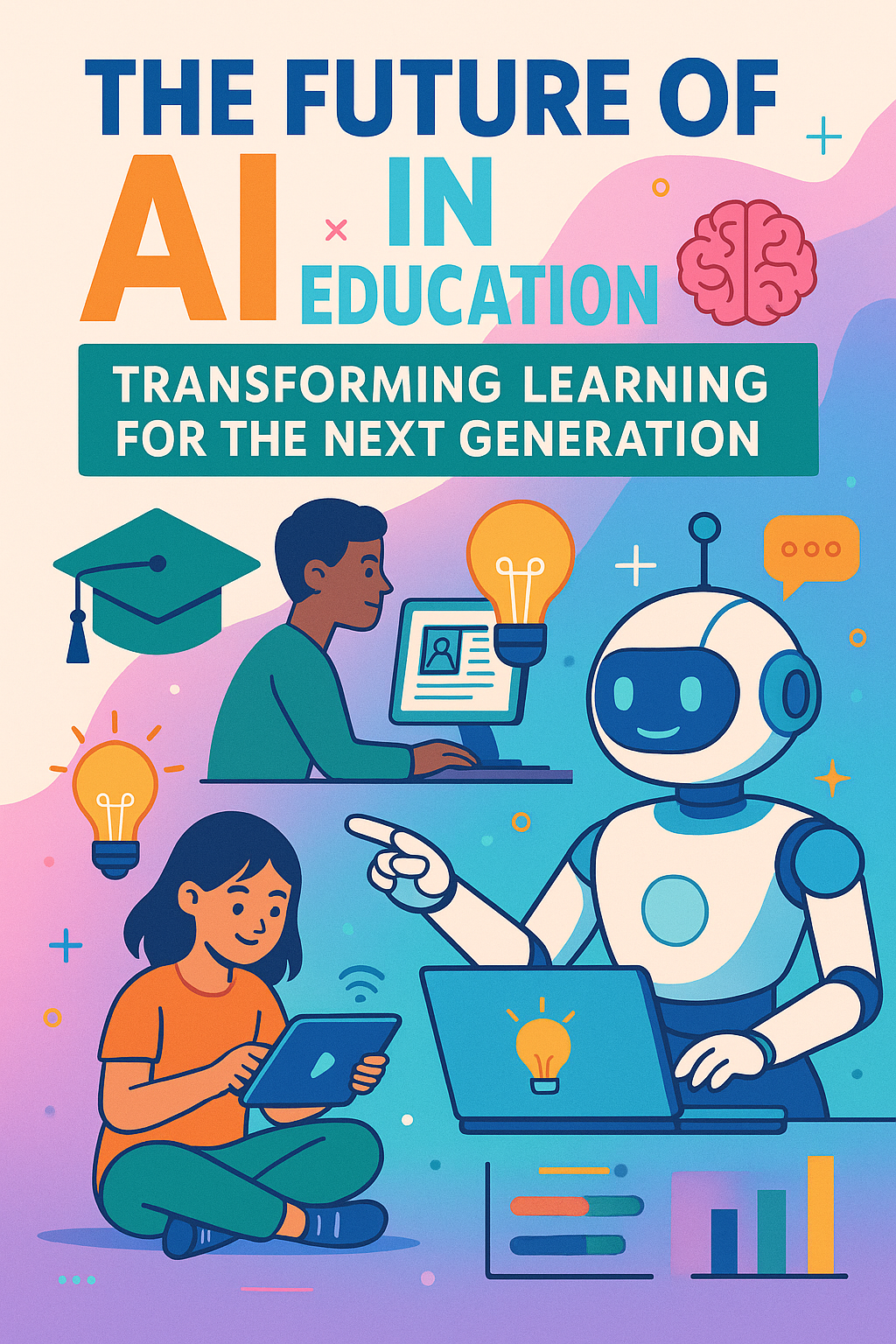
The Future of AI in Education: Transforming Learning for the Next Generation
The Future Of AI In Education: The application of artificial intelligence (AI) within education is transforming the method in which students learn, instructors educate, and establishments perform! AI and automation can offer personalized studying experiences to students whereas slicing down on the administrative burden positioned on educators! The future of schooling seems vivid with AI’s adoption as a result of we will basically be ready to enhance entry to schooling, improve the effectivity of operations, and be ready to adapt studying strategies to every students’ particular studying variations. This blog presents our ideas on how The Future Of AI In Education of schooling, outlining benefits and disadvantages, and the normal transformative nature of AI on education.
What is The Future Of AI In Education?
AI in education is utilizing synthetic intelligence applied sciences like machine studying, pure language processing (NLP), and data analytics to enhance the processes of educating and studying. The use of AI applied sciences permits the design and growth of clever techniques to meet the academic wants of learners, present real-time suggestions, and scale back human workload. Examples of education AI include intelligent tutoring techniques, adaptive studying, and grading automation.
The worldwide AI in education market is probably to develop quickly, with estimates of solely over $20 billion in market measurement by 2027. Progress is pushed by the demand for customized studying experiences, academic gaps that want closing, and digital studying environments.
Key Ways AI is Transforming Education
AI is already taking place in schooling, and its future is limitless. Beneath you will discover some of the most vital areas the place AI will transform education:
1. Personalized Learning Experiences
Perhaps the biggest profit of AI in education is customized studying. Most classroom settings have a commonplace mannequin that is one-size-fits-all, which may go away students struggling to maintain up, and others unchallenged. AI is already being used in adaptive studying techniques to personalize pupil experiences based mostly on particular person strengths, weaknesses, and studying types. AI learning platforms or techniques examine students and customise content material supply.
For Example, let’s contemplate the platforms DreamBox and Smart Sparrow, which make the most of AI in actual time to higher match the issue of classes, however over-simplifying the lesson content. These platforms observe the learner’s progress, misunderstandings, and could present an acceptable advice that targets the studying want. Additional down the street, The Future Of AI In Education might develop a absolutely individualized curriculum based mostly on the similar data about the learner, thus mimicking a customized studying atmosphere the place the learner can study at their very own velocity and of their personal method.
2. Intelligent Tutoring Systems
An AI-driven intelligent tutoring system (ITS) is akin to a digital tutor and offers suggestions and steering on students’ accomplished assignments in actual time. ITS leverage pure language processing (NLP) and machine studying fashions to take in a student’s questions and present an clarification, hinting, or further useful resource in response. An instance of ITS would be Socratic and Duolingo, which create interactive experiences that resemble one-on-one tutoring.
Improvements could lead to more sophisticated platforms by the inclusion of voice recognition and emotional recognition as half of an clever tutor. When used in mixture, the clever tutor might exploit the person’s semantic suggestions to decide their temper and engagement stage, and modify its educating fashion. For instance, The Future Of AI In Education might give a trace to a student who is frustrated or problem one other pupil who expresses confidence.
3. Automating Administrative Tasks
Teachers often emphasize how a lot time they dedicate to administrative duties similar to grading, lesson preparation, and attendance reporting. One of the highly effective points of synthetic intelligence is its capacity to streamline and automate a lot of that administrative workload and free educators to use their time getting ready and educating. An instance of AI-enabled software program is the capacity for machine kinds of cognitive computing to be very correct towards human requirements when grading multiple-choice quizzes, assessments, essays, and even math issues.
Sooner or later, The Future Of AI In Education might automate and streamline even extra complicated tasks, similar to growing lesson plans based mostly on curated curriculum requirements or analyzing all pupil knowledge to uncover at-risk college students, quite than relying on instinctive human observations. Schools might additionally activity AI with producing schedules for college students, optimally assigning assets, or even communication and engagement practices with mother and father.
4. Enhancing Accessibility and Inclusion
Lastly, AI might enable for larger inclusion in education by breaking down obstacles for college students with disabilities or rising each inside and outdoors minority or underserved communities. For instance, AI-enabled instruments such as textual content to speech, real-time translation, and closed captioning, can help each college students who are visually impaired or deaf and hard of hearing (DHH) by making academic content material extra accessible to them. Equally, AI-driven language studying functions can help non-native audio system with new language acquisition.
Sooner or later, The Future Of AI In Education might allow the creation of virtual reality (VR) classrooms that simulate real-world environments, making schooling extra partaking for college students who battle in conventional settings. Additionally, AI might connection gaps in entry to schooling by offering low-cost, scalable options for distant or underfunded faculties.
5. AI Data-Driven Insights for Educators
AI’s capacity to analyze big volumes of information can present educators with relevant information about learners, giving them perception about student efficiency. As an instance, tracking student attendance, grades, and engagement allows ai techniques to know students’ engagement patterns, which informs ai how to produce predictive and prescriptive outcomes. In this case, if ai distills that my students’ engagement is low or absent, then we would need to outline how early we might intervene and support students at threat to succeed.
Think about a future the place ai is related to a learning management system (LMS) (like Canvas or Moodle) and gives academics real-time dashboards that give an educator a larger, broader perspective about their students’ development and engagement with the course materials.
6. Gamification and Immersive Learning
AI can enhance engagement by incorporating gamification and immersive applied sciences into education.
Think about the risk of immersing students in augmented reality (AR) or virtual reality (VR) learning environments that replicate the suspension of disbelief (i.e., the academics would be current at the expertise in a managed setting whereas facilitating educating and learning). Think about our college students exploring historical Rome in a digital classroom or partaking deeply in science experiments in a simulated lab. These immersive experiences might present relevance to beforehand summary ideas and assist students retention and intrinsic motivation.
Challenges of AI in Education
Whereas the potential of AI in education is immense, there are challenges that should be addressed to make sure its profitable implementation.
1. Data Privacy and Security
Noteworthily, ai techniques want to analyze huge portions of student data in order to perform and present the insights. Information sharing, nevertheless, creates concerns about the potential loss of pupil privateness and safety of data like grades, attendance of conduct data. Establishments should take each step attainable to guarantee compliance with The Family Educational Rights and Privacy Act (FERPA), as nicely as different rules and compliance beneath the General Data Protection Regulations (GDPR).
2. Equity and Access
While AI can have the potential to increase equity access in education, it also has the potential to enhance the digital divide. Schools in low-income areas, for instance, may also lack the expertise, infrastructure, or financial capital to properly use AI tools leaving some students behind.
3. Teacher Training and Adoption for AI Education
For AI to be efficient, educators will want to thoughtfully skilled in how to make use of these applied sciences. Usually academics really feel intimidated by new applied sciences or fearful of being changed by AI. Educators want a skilled growth plan that prepares them to meaningfully have interaction with AI and assist them perceive AI is merely one extra software them to educate – NOT its alternative.
4. Ethical Considerations
AI techniques can additionally unwittingly replicate biases if not fastidiously designed from the outset. For instance, an AI grading system skilled on a previous analysis dataset could show democratic biases in direction of the teams of scholars typically evaluated in methods of upholding the systemic biases proven in the knowledge. Builders should prioritize equity and fairness as they assemble AI academic instruments.
The Future Of AI In Education: What’s Next?
As AI continues to evolve, its position in schooling will develop in thrilling methods. Listed here are some tendencies to observe for within the coming years:
1. AI-Powered Lifelong Learning
Lastly, people are more and more adopting a idea of lifelong studying, or upskilling, all through their careers as the life-lengthy, singular job for many individuals is gone. AI has the energy to additional help this work via its capacity to present customized studying pathways for adults based mostly on their objectives and a micro-credential for particular expertise. For example, computer systems on the “massive” studying platforms like Coursera and LinkedIn Studying can information a customers’ growth, and AI would probably make that extra intuitive.
2. AI and Emotional Intelligence
In the future, AI techniques could use emotional intelligence from college students’ knowledge to raised interpret and reply to a learner’s feelings. By deciphering their facial expressions, tone of voice, or written solutions, The Future Of AI In Education might acknowledge and interpret the learners’ indicators of frustration, boredom, or even pleasure and reply extra appropriately.
3. Global Collaboration and Virtual Classrooms
AI could present seamless international collaboration that unites students/teachers throughout borders. Student and instructor group work might take place in digital school rooms utilizing AI tools to immediately translate languages, present fairness, and culturally related content material.
4. AI as a Creative Partner
Students will be ready to use instruments like generative AI to brainstorm and create distinctive alternatives for exploration. Students can rely on AI to set up a story concept, compose tune lyrics, or even designing an artwork challenge. This will require distinctive inventive approaches and might educate college students work with AI instruments and take benefit of co-creation.
Conclusion
The way forward for AI and schooling is vivid with the potential for a extra customized, inclusive, and engaging studying experience for all college students with challenges of knowledge possession and privateness, fairness, and instructor capability. As educators, researchers, know-how builders, and coverage makers transfer ahead, we want to discover common ground, leverage the potential of AI, and guarantee we introduce AI as a software for empowerment quite than division. It will be important that we work collectively to create a larger future for each pupil.
AI is going to revolutionize schooling for generations to come, whether or not via customized studying, clever tutoring, or immersive applied sciences. By adopting these applied sciences, we could be creating the distance studying future the place all learners can flourish.
The Future Of AI In Education